
Prototyping My Path to Teaching
This Practice Portfolio shows how I use hands-on inquiry in my development as a teacher.
Each project is a small prototype: testing how visual and material processes can support learning in the classroom. Through cycles of questioning, trying, noticing and reflecting, I explore how making and observing shape understanding.

Research by Making
Project
Illustration by collage
Question
How can making itself be a way of thinking?
Action
I worked directly with textiles and collage: cutting, layering, stitching, reworking.
Finding
Through making, ideas emerged that theory alone could not predict.
Reflection
Making is more than producing an outcome. It is a way to think, feel, and connect with the process. I want students to share that same depth of discovery.
Iteration
Project
Protoype variations
Question
What happens when an idea is reworked, and when space is made to warm up?
Action
I began each cycle by working loosely, like warming up in sport: sketching or making without pressure, then moving into refining and repeating.
Finding
The warm-up stage opened new directions. Iteration became less about fixing and more about discovering.
Reflection
As a teacher-in-training, I see how important it is for students to give themselves room to loosen up — approaching each round with fresh energy and openness.


Action & Reflection
Project
Balancing doing and thinking
Question
How does reflection deepen hands-on action?
Action
I moved between quick prototypes and pauses to note ideas and connect them to context, where inspiration came from and how my work responded.
Finding
Reflection became more than looking back: it opened new possibilities by placing making in dialogue with history and existing ideas.
Reflection
Students can see that making is never in isolation, their work grows by responding to what is already there.
Participation
Project
working in a group
Question
What can students learn by creating together?
Action
I would facilitate a shared textile surface where each student adds a stitch or patch, individual actions that begin to influence one another.
Finding
Playful energy, resistance and disruption might intertwine, merging into something new.
Reflection
Shared making can reveal that learning is relational and dynamic. Every action matters, and collective work becomes more than the sum of its parts.

Material Thinking
Project
Ideas from materials
Question
How do materials themselves generate ideas?
Action
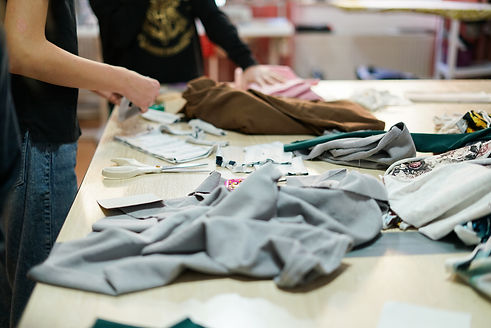
I explored fabric, thread and found objects without a fixed plan. Folding, tearing and testing their limits. I combined colours and textures from different subcultures, letting clashes spark new possibilities.
Finding
The materials pushed back: their weight and texture shaped outcomes I hadn’t foreseen. Accidents became new directions.
Reflection
When materials move beyond their usual context, they change meaning, and so do we. Material thinking helps students embrace difference, surprise and transformation through what they make.
Documentation
Project
learning journals
Question
How does documenting deepen learning?
Action
I photographed, sketched and collected samples giving attention to each stage of making.
Finding
Documentation opened a dialogue with the process, revealing that even mistakes hold value.
Reflection
For students, tracking their process becomes both record and reward, showing how far they’ve come and how much they’ve learned.


Making Public
Project
Preparing to share
Question
How does preparing to share shape learning?
Action
I explored how to present my process so others could follow, thinking about what they see, need and understand across different media.
Finding
Preparing to share made me step outside my own view, anticipate gaps, and shape the work to connect.
Reflection
For students, making public is about framing ideas with care, building empathy for the audience and confidence in telling their own learning story.
Circle of Doing Research
Project
Teaching as ongoing research
Question
What happens when learning is treated as a research cycle?
Action
I explored learning as a loop of trying, reflecting, adjusting and repeating, each round reshaping the next.
Finding
When stuck, shifting between stages, from doing to reflecting, opened new ways forward.
Reflection
Learning is never linear. The cycle offers structure and flexibility, helping both teachers and students keep moving through uncertainty.
